
Introduction
Choosing the right elevator for your building is one of the most significant investment decisions you will make as a property owner, builder, or developer. A poorly selected elevator leads to years of operational inefficiency, frequent breakdowns, high maintenance costs, and passenger dissatisfaction. On the other hand, the right elevator — matched to your building's traffic patterns, structural constraints, and usage profile — delivers reliable service for 20+ years with minimal downtime.
In Chennai, where building regulations under the Tamil Nadu Lift Act and CMDA guidelines impose specific requirements, the decision becomes even more nuanced. Coastal climate conditions, power supply variations, and local installation practices all factor into the selection process. This guide walks you through every decision point with clarity and technical depth.
What will you learn from this guide?
Why This Guide Matters
In our 12+ years of elevator design, installation, and service across Tamil Nadu, we have seen too many building owners make the same mistakes: choosing an undersized elevator to save costs upfront, ignoring machine room requirements during structural planning, or selecting a hydraulic system when an MRL would have been more efficient. Each of these mistakes costs significantly more to fix later than it would have to get right the first time.
This guide is written for:
- Homeowners & Villa Owners — Adding a home elevator for convenience, aging-in-place, or property value.
- Builders & Developers — Specifying elevators for apartment complexes, commercial projects, and mixed-use developments.
- Architects & Consultants — Integrating elevator systems into building designs with accurate shaft dimensions and load calculations.
- Facility Managers — Replacing or modernizing existing elevators with up-to-date technology.
Step 1: Understand the Six Elevator Types
Every elevator installation begins with one fundamental question: which type of elevator technology suits your building? The choice depends on travel height, available space, load requirements, speed expectations, and budget. Here is a detailed breakdown of each type.
1. Home Elevator (Residential)
Purpose-built for private residences, home elevators are compact, operate on single-phase power (230V), and prioritize smooth, quiet operation. They typically carry 2–5 persons (250–500 kg) at speeds of 0.5–1 m/s. Most modern home elevators are MRL (Machine Room Less), requiring no separate machinery room. Cabins range from 0.8 m² to 1.2 m², fitting within standard villa layouts. The 2025–26 trend in Chennai sees a 40% increase in home elevator installations driven by aging populations and rising property values.
2. Passenger Elevator
The standard choice for apartment buildings, offices, hotels, and commercial complexes. Passenger elevators are available in capacities from 630 kg (8 persons) to 1600 kg (21 persons) with speeds ranging from 1 m/s to 2.5 m/s for mid-rise applications. They operate on three-phase power and require careful traffic analysis to determine the right number and size of cars for your building. Features include automatic sliding doors, hall call buttons, car operating panels, and destination dispatch systems.
3. MRL (Machine Room Less) Elevator
The most significant elevator innovation of the past two decades. MRL elevators house the machine and controller within the shaft, eliminating the need for a dedicated machine room. This saves 10–15 m² of valuable floor space per elevator. Available in capacities from 320 kg to 1600 kg, MRL elevators serve up to 16 floors at speeds of 1–2 m/s. They use permanent magnet synchronous gearless motors (PMSGM) that are highly energy-efficient and quiet. MRL is the preferred choice for new buildings and retrofits where space optimization is critical.
4. Hydraulic Elevator
A proven technology where a hydraulic cylinder and piston system moves the car. Hydraulic elevators excel at heavy loads (500–5000 kg) and low-rise applications (up to 6 floors). They are ideal for warehouses, factories, car parks, and low-rise commercial buildings. The machine room can be located at ground level adjacent to the shaft (not above), which is advantageous when overhead space is limited. However, hydraulic systems consume more energy than MRL or traction elevators and require regular oil changes and seal maintenance.
5. Traction Elevator (Geared & Gearless)
The workhorse of high-rise buildings. Traction elevators use steel ropes or belts passing over a drive sheave connected to an electric motor. Geared traction elevators use a gearbox to drive the sheave (suited for mid-rise, speeds up to 2.5 m/s), while gearless traction elevators have the motor directly coupled to the sheave (suited for high-rise, speeds up to 10 m/s). For buildings above 12 floors in Chennai, gearless traction is the standard. They require a machine room located directly above the shaft.
6. Glass / Capsule Elevator
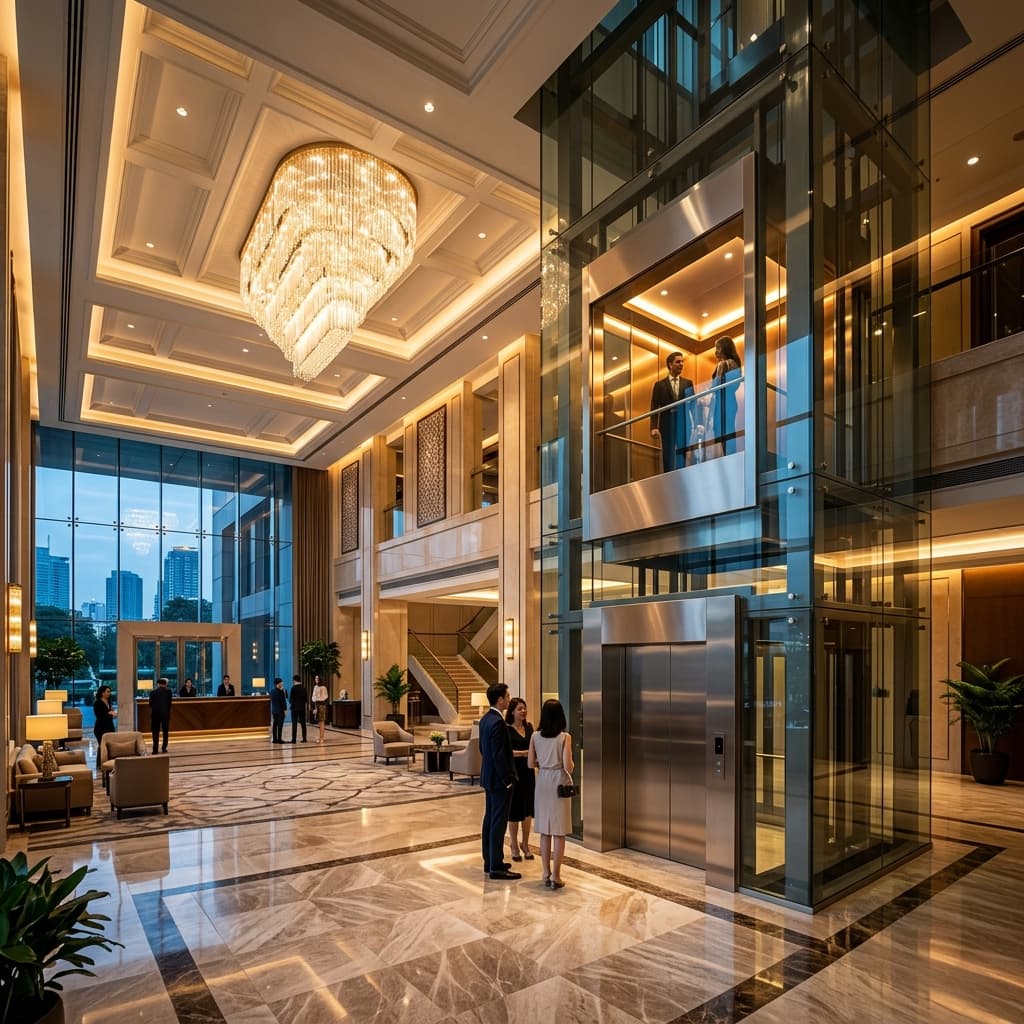
Aesthetic-focused elevators with transparent glass cabins and often glass-backed shafts. They serve 2–10 floors with capacities of 320–1000 kg. Popular in luxury villas, showrooms, shopping malls, and hotel lobbies. Glass elevators are available in MRL or hydraulic configurations. The glass panels require specialized cleaning and maintenance, especially in Chennai's coastal environment where salt accumulation can reduce transparency over time.
“The single biggest mistake we see is choosing an elevator type based only on upfront cost. A hydraulic elevator might save you 15% on the initial purchase, but over 15 years, an MRL elevator will save you 30-40% in energy and maintenance costs in a residential application.”
Step 2: Determine the Right Capacity
Capacity is measured in kilograms (kg) and expressed as the number of persons the elevator can carry (1 person ≈ 75 kg as per IS 14665). Undersizing leads to excessive wait times and overcrowding. Oversizing wastes energy, increases installation cost, and occupies unnecessary shaft space.
| Application | Recommended Capacity | Persons |
|---|---|---|
| Home / Villa | 250–400 kg | 3–5 |
| Apartment (4–6 floors) | 630–800 kg | 8–10 |
| Apartment (7–12 floors) | 800–1000 kg | 10–13 |
| Office / Commercial | 1000–1275 kg | 13–17 |
| Hospital | 1600–2500 kg | Stretcher + Team |
| Warehouse / Goods | 2000–5000 kg | Goods + Trolley |
For apartment buildings, a common rule of thumb is one elevator per 30–40 units. Buildings with 12+ floors typically require two elevators — one for passenger traffic and one service/goods elevator. Traffic simulation studies during the design phase help optimize the number, capacity, and speed of elevators for commercial projects.
Step 3: Choose the Right Speed
Elevator speed is measured in metres per second (m/s). The right speed balances passenger wait time expectations with cost and energy consumption. Faster elevators require more powerful motors, sophisticated controllers, and enhanced safety systems — all adding to the cost.
- 0.5–1 m/s: Ideal for home elevators and buildings up to 4 floors. Smooth, quiet, and energy-efficient.
- 1–1.75 m/s: Standard for residential apartments up to 10 floors and mid-rise commercial buildings.
- 2–2.5 m/s: Recommended for buildings with 11–20 floors. Provides acceptable wait times for medium-traffic buildings.
- 3–4 m/s: High-speed elevators for buildings with 21–40 floors. Requires gearless traction technology.
- 5–10 m/s: Ultra high-speed for skyscrapers above 40 floors. Rare in Chennai (current maximum building height is limited by CMDA regulations).
Speed selection also depends on the control system. Variable Voltage Variable Frequency (VVVF) drives provide smooth acceleration and deceleration, reducing mechanical wear and improving ride comfort compared to older dual-speed AC systems.
Step 4: Machine Room — To Have or Not to Have
One of the most consequential decisions in elevator selection is whether to have a machine room. This decision affects your building's structural design, usable floor area, and long-term maintenance convenience.
Machine Room Less (MRL)
MRL elevators use compact permanent magnet motors mounted on the guide rail at the top of the shaft. The controller is installed in a cabinet within the shaft or on the top floor landing. Benefits include: no machine room cost (saving ₹1–3 lakhs in construction), complete design flexibility, and easier installation in existing buildings. MRL is the default choice for new installations across Chennai for buildings up to 16 floors.
Traditional Machine Room
Required for traction elevators (geared and gearless) and most hydraulic installations. The machine room houses the motor, controller, governor, and cabling. A well-designed machine room provides easier access for maintenance, better cooling for equipment, and longer component life. However, it consumes 10–15 m² of premium floor space (typically on the roof), adds structural load, and increases construction cost.
Step 5: Energy Efficiency & Noise Considerations
Energy consumption and noise are two factors that elevator buyers often overlook — until the first electricity bill or the first complaint from a bedroom adjacent to the shaft.
Energy Efficiency
Modern elevators are significantly more energy-efficient than models from even a decade ago. Key technologies driving efficiency include:
- Regenerative Drives: Capture energy during braking and feed it back into the building's electrical system, reducing overall consumption by 25–40%.
- LED Lighting: Replacing fluorescent cabin lights with LEDs reduces lighting energy by 70–80%.
- Standby Mode: Elevators automatically switch to low-power standby when idle for a set period (typically 5–10 minutes).
- Permanent Magnet Motors: Used in MRL elevators, these motors are 15–20% more efficient than conventional induction motors.
Noise & Vibration
Elevator noise levels are measured in decibels (dB). A well-installed MRL elevator operates at 45–55 dB inside the cabin — comparable to a quiet conversation. Key noise sources include door operators (opening/closing), guide rail contact, and machine vibration transmitted through the building structure. For home installations, request acoustic isolation mounts between the guide rail brackets and the building structure. Always verify noise levels during the factory acceptance test (FAT) before installation.
Step 6: Safety Features to Prioritize
Elevator safety is governed by IS 14665 (Indian Standard for Electric Traction Elevators) and the Tamil Nadu Lift Act. Beyond regulatory compliance, certain features significantly enhance passenger safety and peace of mind.
| Safety Feature | Importance | Mandatory? |
|---|---|---|
| Emergency Alarm & Intercom | Critical — allows trapped passengers to call for help | Yes |
| Automatic Rescue Device (ARD) | Critical — moves car to nearest floor during power failure | Recommended |
| Speed Governor + Overspeed Brake | Critical — mechanically engages if elevator exceeds rated speed | Yes |
| Door Sensors (Light Curtain) | High — prevents door closure on objects/persons | Yes |
| Overload Indicator | High — prevents operation when overloaded | Yes |
| Emergency Lighting | High — illuminates cabin during power failure | Yes |
| Fire-Rated Landing Doors | High — contains fire spread between floors | Yes |
| Battery Backup | Medium — powers emergency systems during outage | Recommended |
| Remote Monitoring (IoT) | Medium — real-time diagnostics and breakdown alerts | Optional |
| Earthquake Sensor | Low (in Chennai) — automatic landing at nearest floor during seismic event | Optional |
For home elevators, we strongly recommend adding a CCTV camera inside the cabin and a telephone auto-dialer that contacts pre-programmed numbers during emergency. These are low-cost additions that provide significant peace of mind, especially when children or elderly family members use the elevator.
Step 7: Cabin Design & Customization
The elevator cabin is the most visible part of your investment. A thoughtfully designed cabin enhances user experience, complements your building's interior, and in commercial settings — reinforces your brand identity.
Cabin Materials
- Stainless Steel (304 Grade): Most popular choice for Chennai. Highly durable, corrosion-resistant (essential for coastal climate), easy to clean, and available in brushed, mirror, or textured finishes.
- Glass: Creates a spacious feel. Choose tempered (safety) glass with anti-fingerprint coating. Requires frequent cleaning in Chennai's dusty conditions.
- Wood Veneer / Laminate: Warm, residential aesthetic. Must be marine-grade or high-pressure laminate to withstand humidity. Not recommended for ground-floor installations with direct outdoor exposure.
- Paint / Powder Coating: Most affordable option. Limited durability compared to SS or laminate. Best for service or goods elevators.
Flooring & Lighting
Flooring options include vitrified tiles, granite, marble, and anti-skid rubber. For home elevators, consider heated flooring in colder months. Lighting should be LED with 150–200 lux illumination. Recessed downlights, cove lighting with RGB options, and skylight-effect panels are popular premium choices. Handrails in stainless steel or wooden finish improve accessibility for elderly users.
Step 8: Budget & Cost Factors
Elevator pricing in India spans a wide range depending on type, capacity, number of stops, and customization. Understanding the cost breakdown helps you allocate budget realistically and avoid surprises.
Typical price ranges for Chennai (2026):
| Elevator Type | Price Range | Typical Use |
|---|---|---|
| Home Elevator (MRL) | ₹3.5 – 8 Lakhs | Villas, Independent Homes |
| Passenger Elevator | ₹8 – 25 Lakhs | Apartments, Offices |
| MRL Elevator | ₹6 – 20 Lakhs | New Buildings, Retrofits |
| Hydraulic Elevator | ₹5 – 18 Lakhs | Warehouses, Low-Rise |
| Traction Elevator | ₹12 – 40 Lakhs | High-Rises, Hotels |
| Glass / Capsule | ₹8 – 30 Lakhs | Showrooms, Luxury Villas |
Hidden Costs to Plan For
- Civil Works: Shaft construction, pit excavation, machine room (if needed), and structural reinforcement. Typically ₹1–5 lakhs depending on building condition.
- Electrical: Dedicated power supply, cabling from main panel to elevator, and backup power integration. ₹50,000–2 lakhs.
- Permits & Approvals: CMDA approval, Tamil Nadu Lift Act registration, and inspection fees. ₹25,000–75,000.
- AMC: Annual Maintenance Contract (covered in Step 10). ₹15,000–50,000 per year for home elevators.
Always request itemized quotations from at least three vendors. Compare not just the elevator price but also civil works scope, delivery timeline, warranty terms, and AMC rates. Beware of quotes that seem significantly lower than market rates — they often exclude critical components or use sub-standard materials.
Step 9: Plan the Installation Timeline
Understanding the installation timeline helps you coordinate with your construction schedule and set realistic expectations with building users.
| Phase | Duration | Key Activities |
|---|---|---|
| 1. Site Survey | 2–3 days | Shaft measurement, structural assessment, electrical inspection, access route planning |
| 2. Civil Preparation | 1–2 weeks | Shaft construction, pit digging & waterproofing, beam installation, machine room prep |
| 3. Guide Rail Installation | 1–2 weeks | Rail bracket fixing, rail alignment & plumb, counterweight rail installation |
| 4. Cabin & Door Installation | 1–2 weeks | Cabin assembly, door frames & panels, landing door installation, sill fixing |
| 5. Electrical & Controls | 1 week | Controller mounting, VVF drive wiring, call station installation, cable harnessing |
| 6. Testing & Commissioning | 3–5 days | Load test, speed test, safety device verification, emergency operation test, certification |
| 7. Handover | 1 day | Documentation, user training, AMC commencement, spare parts handover |
Total estimated timeline: Home elevators — 2 to 4 weeks. Commercial passenger elevators — 4 to 8 weeks. Complex multi-elevator projects — 8 to 16 weeks. Delays often occur during civil preparation (unforeseen structural issues) and during testing/certification (compliance documentation delays). Build a buffer of 2 weeks into your project timeline.
Step 10: Evaluate Warranty & AMC
An elevator is a long-term asset. The warranty and Annual Maintenance Contract (AMC) terms you negotiate at purchase will define your ownership experience for the next 20+ years.
Standard Warranty Coverage
Reputable manufacturers offer a minimum 12-month comprehensive warranty covering all parts, labour, and service calls. Premium brands now offer extended warranties of 24–36 months on key components (motor, controller, drive). Verify what is excluded: often batteries, bulbs, and rubber seals are wear-and-tear items not covered under warranty.
Annual Maintenance Contract (AMC)
AMC plans come in two tiers:
- Basic AMC (₹15,000–25,000/year for home): Includes monthly preventive maintenance, emergency breakdown call-out, labour charges. Spare parts billed separately.
- Comprehensive AMC (₹25,000–50,000/year for home): All basic services PLUS full spare parts coverage including motor, controller, drive, door operator, and safety devices. Budget-friendly and recommended.
Expert Tips from Asco Engineers
Common Mistakes to Avoid
Final Checklist — Before You Buy
Use this checklist when evaluating proposals and meeting with elevator suppliers. Each checked item brings you closer to a successful installation.
- Shaft dimensions measured and verified by a qualified engineer on site
- Elevator type selected based on travel height, load, and building constraints
- Capacity determined using traffic analysis (for commercial) or occupancy assessment (for residential)
- Speed selected appropriate for building height and expected traffic
- Machine Room Less (MRL) confirmed as viable option, or machine room space allocated
- VVVF drive confirmed in the quotation (not dual-speed AC)
- Automatic Rescue Device (ARD) included in the scope
- Full list of safety features reviewed and compliant with IS 14665
- Cabin finish, flooring, lighting, and handrails finalized before shaft construction
- Itemized quotation received from at least 3 vendors — scope compared line by line
- Civil works cost (pit, shaft, machine room) included in the overall budget
- Electrical infrastructure (dedicated power, cabling, backup) planned
- CMDA and Tamil Nadu Lift Act permit process understood and budgeted
- Installation timeline agreed in writing with milestone dates and penalties for delays
- Warranty terms reviewed — minimum 12 months comprehensive with extended options
- AMC plan selected — basic or comprehensive — with first-year charges confirmed
- Manufacturer references contacted — site visit arranged to see working installation
- After-sales support response time (breakdown) confirmed in writing
Pros & Cons of Each Elevator Type
A side-by-side comparison of the advantages and limitations of each elevator technology.
Home Elevator (MRL)
- Compact design fits in standard villa layouts
- Operates on single-phase power (230V) — no three-phase required
- Quiet operation — ideal for residential settings
- No machine room needed — saves 8–12 m² of space
- Energy efficient with LED lighting and standby mode
- Lower installation cost compared to commercial elevators
- Limited to 250–500 kg capacity — not suitable for heavy goods
- Maximum travel typically 4–6 floors
- Slower speeds (0.5–1 m/s) — not for high-traffic buildings
- Limited cabin customization compared to passenger elevators
- May require structural reinforcement in older homes
Hydraulic Elevator
- Handles very heavy loads (up to 5000 kg) — ideal for goods/warehouse
- No overhead machine room — machine room at ground level
- Suitable for low headroom buildings
- Proven technology with simple mechanical operation
- Lower initial cost for low-rise (2–4 floor) applications
- Easier to install in existing buildings with limited shaft access
- Higher energy consumption compared to MRL and traction
- Requires regular oil changes and seal maintenance
- Slower operating speed — typically 0.5–1 m/s
- Hydraulic oil leaks can cause environmental and safety concerns
- Machine room occupies ground-level space adjacent to shaft
- Not suitable for buildings above 6 floors
Traction Elevator (Gearless)
- Fastest speeds — up to 10 m/s for high-rise applications
- Highly energy-efficient with regenerative drives
- Smooth and quiet ride quality — best-in-class comfort
- Suitable for unlimited travel height
- Long service life — 25+ years with proper maintenance
- Can serve 40+ floors without intermediate machine rooms
- Highest initial investment among all types
- Requires dedicated machine room at top of shaft
- Machine room adds structural load and consumes floor area
- More complex installation — requires specialized engineering
- Three-phase power mandatory — not suitable for residential single-phase
- Overhead clearance of 4500–5500 mm required
Cost & Feature Comparison
Compare the key specifications of each elevator type side by side to make an informed decision.
| Feature | Home | Passenger | MRL | Hydraulic | Traction | Glass |
|---|---|---|---|---|---|---|
| Capacity | 250–500 kg | 630–1600 kg | 320–1600 kg | 500–5000 kg | 630–2500 kg | 320–1000 kg |
| Speed | 0.5–1 m/s | 1–2.5 m/s | 1–2 m/s | 0.5–1 m/s | 1–4 m/s | 0.5–1.5 m/s |
| Max Travel | Up to 6 floors | Up to 20 floors | Up to 16 floors | Up to 6 floors | Up to 40+ floors | Up to 10 floors |
| Machine Room | MRL / No | Yes / MRL | No | Yes (side) | Yes (overhead) | MRL / Yes |
| Power Phase | Single | Three | Single / Three | Three | Three | Single / Three |
| Best For | Villas, Homes | Apartments, Offices | Space-constrained | Warehouses, Low-rise | High-rises, Hotels | Showrooms, Luxury |
| Noise (dB) | 45–52 dB | 50–60 dB | 48–55 dB | 55–65 dB | 50–58 dB | 48–55 dB |
| Energy Rating | A++ | A+ | A++ | B | A+ | A+ |
| Price Range | ₹3.5–8L | ₹8–25L | ₹6–20L | ₹5–18L | ₹12–40L | ₹8–30L |
| Annual AMC | ₹15–25K | ₹30–80K | ₹20–50K | ₹25–60K | ₹40–100K | ₹25–50K |
Frequently Asked Questions
Common questions answered by our engineering team with over 12 years of experience in elevator design and installation across Chennai and Tamil Nadu.